Articles
 Quarterly Investor Calls
 ITUS Long & Short
 ITUS Snippets


 Articles
 Quarterly Investor Calls
 ITUS Long & Short
 ITUS Snippets


by Dinesh Chinnasamy
July 10, 2026

Investing in growth in the public markets
Study our investing style and process at length

Owner's Manual
We are a fiduciary of your capital. Your understanding of what we do and how we will approach it is a critical element in enabling us to attain our goal. The Owners Manual helps achieve this....


The Physical world is back in favour
For nearly two decades, markets handsomely rewarded businesses that owned as little as possible. Software, platforms and digital services created immense value with relatively little physical infrastructure. Companies that could scale without factories, grids or heavy equipment became the market’s biggest winners.
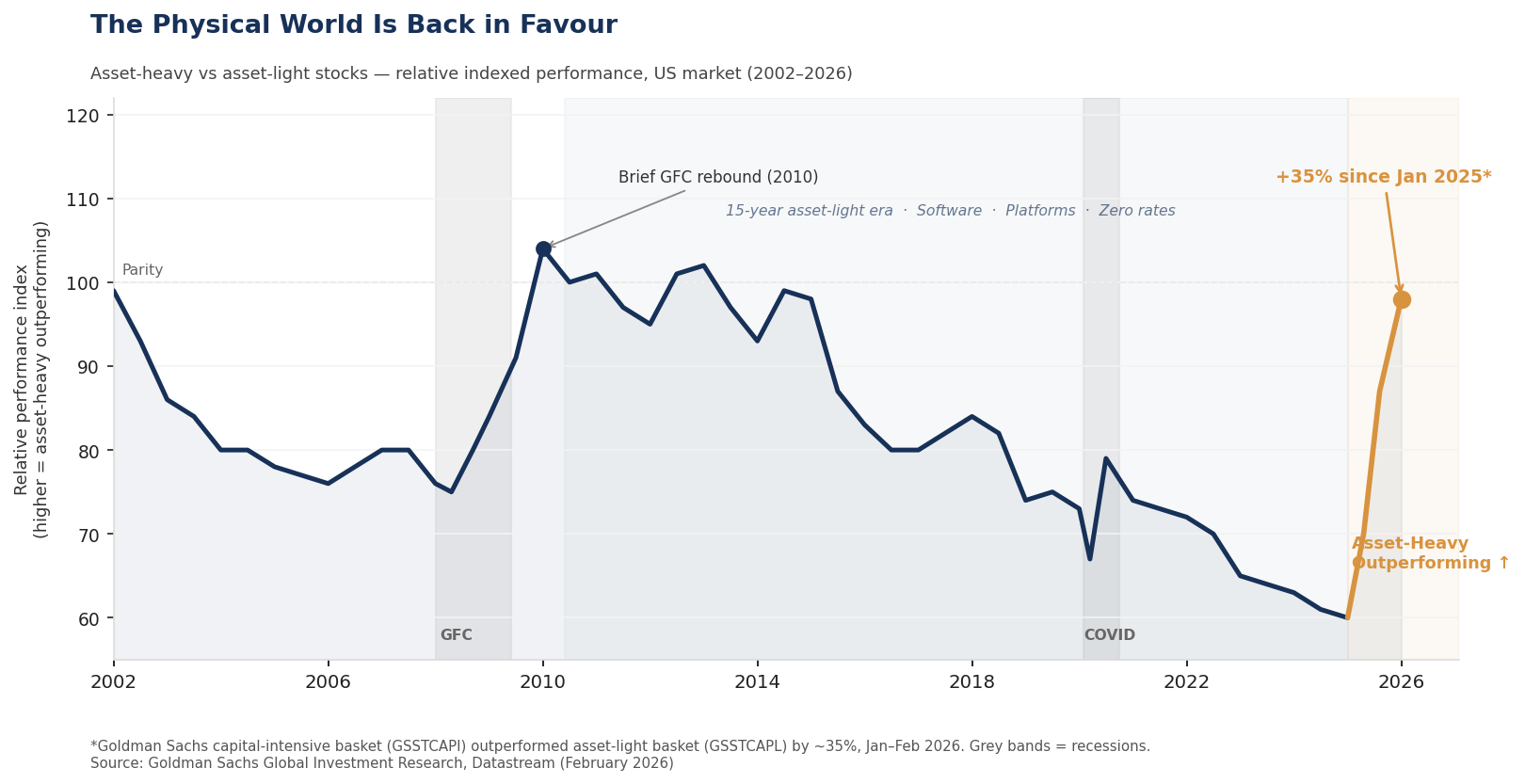
The age of asset-light business models was long, profitable and, at times, appeared permanent.
That trend may be changing.
According to Goldman Sachs, its basket of capital-intensive companies has outperformed asset-light businesses by approximately 35% since the start of 2025. The bank attributes this shift to what it calls the ‘HALO effect – Heavy Assets, Low Obsolescence’.
These are businesses built around physical infrastructure: utilities, power grids, pipelines, industrial equipment and other assets that are expensive to build, difficult to replicate and unlikely to become obsolete overnight.
Interestingly, the catalyst is AI itself.
The five largest AI hyperscalers; Amazon, Microsoft, Alphabet, Meta and Oracle are expected to spend roughly $1.5 trillion on AI infrastructure between 2023 and 2026. In 2026 alone, their combined capital expenditure is projected to exceed $650 billion, more than what they collectively spent in all the years prior to 2022. The implication is worth reflecting on. While AI is often viewed as a software story, its adoption is proving to be deeply physical. Data centres require power. Power requires generation, transmission and distribution infrastructure. That infrastructure requires copper, steel, engineering expertise and decades of accumulated industrial capacity.
In many ways, the digital economy is being built on a very physical foundation.
Markets appear to be recognising this shift. After years of favouring businesses with minimal tangible assets, investors are increasingly rewarding companies that build, own and operate critical infrastructure.
Whether this marks a temporary rotation or the beginning of a longer-lasting change remains to be seen. However, the scale of the investment cycle underway suggests that the demand for physical assets may not be a short-lived phenomenon.
For investors, the broader lesson may be that major technological revolutions rarely benefit only the innovators. They also create opportunities for the businesses that provide the foundations upon which those innovations are built.
This observation is particularly relevant in markets such as India.
While much of the attention around AI remains focused on software and digital platforms, India’s opportunity set extends far beyond technology. The country’s ongoing investment cycle is increasingly visible across power generation, transmission networks, industrial manufacturing, healthcare infrastructure and the broader resources ecosystem.
As investment shifts from the virtual layer of the economy to the physical layer, businesses operating in these sectors could find themselves on the right side of a structural trend. Portfolios built around themes such as power, resources, healthcare and industrials may therefore be participating in a much larger story than a traditional cyclical recovery.
Subscription Details
Itus Capital’s fund follows a staggered subscription model, with subscription windows opening on a fortnightly basis.
You may visit the link below to read our previous contents and keep following us for more like these.
As always, we keep re-emphasising our SIP mode of investment. You can connect with your relationship manager to know more about our SIP Program.
Weekly Insight Digest Archives – ITUS Capital